


Stomababe Interview: What People Miss About Hidden Disabilities
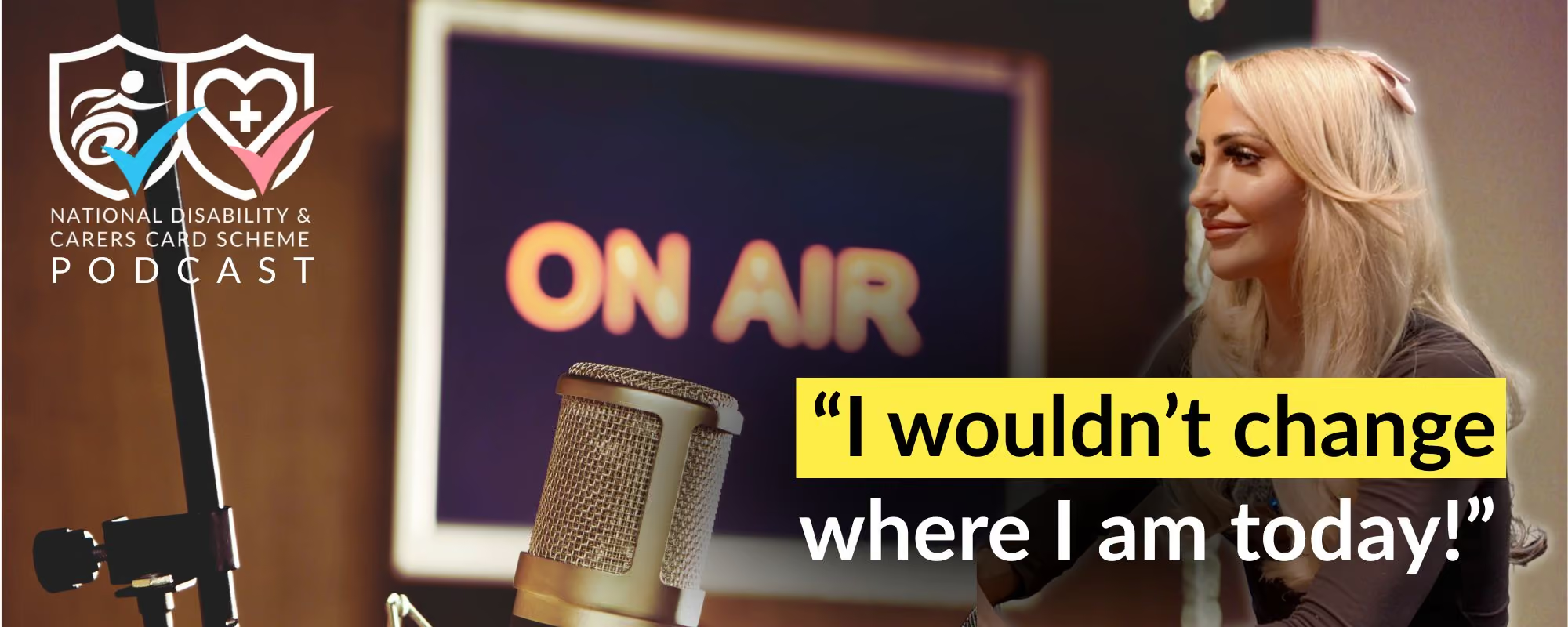
In this episode of our podcast we talk to Holly about her journey with ulcerative colitis that led to life-changing stoma surgery. Holly became Stomababe by sharing her lived experience online, finding community, challenging misconceptions around hidden disability and neurodivergence, and advocating for compassion, accessibility, and speaking up. Please note the content of the podcast has been abridged and paraphrased for readability. You can watch or listen to the full podcast using the links below.
How did you become 'Stomababe'?
Not at all. If you’d told me ten years ago I’d be using that name online, I wouldn't have believed it. I never imagined I’d have a stoma bag, let alone be known for talking about it.
It all started when I was very unwell and in hospital in 2021 for about eight weeks. I was in a lot of pain and couldn’t do much—so I ended up sharing Instagram stories about what was going on. At first it was just friends and family, but people began sharing my stories with others who’d been through similar things. My audience grew, and people started messaging me about colitis and stoma life. That was huge for me, because I didn’t know what to expect. When I left hospital, I kept posting—partly because it helped me, and partly because I realised it might help others too.
Why was hearing from others so important at that point?
I was in a very low place and terrified. Bowel diseases aren’t openly talked about, so you don’t grow up seeing real examples of what life looks like after surgery or with a stoma. You can read medical definitions online, but lived experience is hard to find.
I’d only been diagnosed with ulcerative colitis a year before I was told I needed a life-changing operation. I didn’t have time to research; I didn’t know anything about stoma bags. I also had misconceptions—I thought stomas were only for “old people” or a last resort, and I genuinely believed my life was over. People messaging me and showing me they were living full lives—working, exercising, enjoying things—helped me reframe everything.
What was your health journey like leading up to diagnosis?
I’d had stomach issues for a couple of years, but like lots of people with inflammatory bowel disease, I was told it was IBS or piles—common things, especially when you’re young.
Diagnosis often requires colonoscopy and referral, and that can take time. I was referred, but early on nothing showed up. That can happen—if you’re not actively flaring at that moment, it might look normal. Later, when I started a new job and my schedule changed, symptoms escalated. I began seeing blood and had urgency. My younger brother has Crohn’s, so I knew it was serious. Another colonoscopy finally showed it, and I was then diagnosed.
Once you were diagnosed, did you expect it to become as severe as it did?
I was initially told my UC was mild and that I wouldn’t need strong treatment or surgery. I trusted that. I took the first-line medication, but it never worked from day one. I kept saying it wasn’t controlling anything, but it was a time when appointments were harder to access, so it became a cycle of emails saying “carry on with the meds.”
The problem is: the longer something like colitis stays uncontrolled, the worse it can get—like a fire spreading. Looking back, I wish someone had taken me more seriously. At the time, I thought, “Maybe this is just my life now.” There’s only so many times you can email or go to A&E and be told you’re fine, before you start believing it.
Many people fear stoma surgery as a “worst case.” How do you feel about it now?
I used to think it was worst case too—until I lived through uncontrolled colitis. That was the worst case. It affected everything. I couldn’t work, couldn’t enjoy events, couldn’t be present with friends. I remember being at a hen do, camping, and spending the whole time in a tent in pain. I’d show up, but I wasn’t really there.
Now, with my bag, I make adjustments—but I’m not writhing in pain at events. I’m not collapsing with fatigue. I can actually enjoy my life again. It’s not perfect, but it’s a million times better than being trapped in constant illness.
What do you wish people understood about hidden disabilities?
The fluctuations. You can feel completely fine one day and be totally out of action the next. Most people only see you on good days—when symptoms are managed and you look “normal.” They don’t see you at your lowest.
Because disability is often expected to be visible, people struggle to understand what they can’t immediately see. You see it with mobility aids too—like when someone doesn’t always use a wheelchair and people assume they must be lying. There are so many misconceptions about what disability “looks like,” and it can be exhausting having to explain or justify yourself.
For most of us, we’re not asking for special treatment—just a bit of compassion and inclusion.
How has the online community helped you? and what challenges come with it?
The biggest positive is not feeling alone. Seeing others’ stories helped me feel less isolated and less “strange.” It’s reassuring to see people in similar situations living full lives.
But there are challenges too—mean comments, assumptions, people not understanding hidden disability. I try to remember that it’s not always personal; sometimes people just haven’t experienced anything like it. That’s why I try to include an educational element in what I post, and I try to show both the highs and lows—because that’s what real life with chronic illness or disability looks like.
You’ve also been sharing about ADHD and autism. How did that journey unfold?
After getting the physical side of things under control, I realised I still didn’t feel okay mentally. I’ve lived with anxiety and depression for a long time, and nothing I tried seemed to fix it. I started to think, “Maybe this is just who I am. Maybe I’m just bad at life.”
Then I began seeing content—especially from women—about ADHD and autism, and it felt like someone was holding up a mirror. I finally recognised myself. It was emotional, because I realised I’d been bullying myself internally for years, thinking I was wrong or broken, when actually my brain works differently.
Getting diagnosed and starting ADHD medication was a massive “light bulb” moment. Since then, I’ve been learning coping strategies and also learning to be kinder to myself.
What do you want others to know about neurodivergence, especially “masking”?
People assume if you have a job or a child or you seem “fine,” you can’t be autistic or ADHD. But many people learn to mask for years, especially if they’re high functioning. You might look put together on the outside, but people don’t see the prep, the overwhelm, or the crashes.
I talk about it because it helps others feel less ashamed. Just because someone looks okay online doesn’t mean they don’t struggle. It’s not shameful to have hard days.
What’s helped you manage disability and neurodivergence at work?
Communication, especially in a way that works for you. Face-to-face conversations can be hard for me, especially with senior staff, so I often use email. It gives me time to think and write clearly.
If you can, speak to HR. Some workplaces can refer you to occupational health, which can be really helpful. They’ll put together a report of accommodations so you don’t have to carry the whole burden of explaining.
And it’s important to remember: if you have a disability, you’re entitled to reasonable adjustments. Sometimes small changes, like seating location or being closer to a toilet make a huge difference.
You mentioned a workplace toilet situation. What happened?
There was only one disabled toilet and it was often in use, which caused me anxiety. I didn’t want to do a face-to-face conversation about it, so I emailed someone in HR. They were really kind and helpful—and they put a sign on the door about invisible disabilities.
Someone else messaged me afterwards saying, “I didn’t know you could ask for that.” That’s why speaking up matters. If you don’t ask, you don’t know what can change—and sometimes one change helps many people after you.
You’re a National Disability Card holder. How did you first hear about it?
My mum found it, honestly! Even at 32, she still helps me with admin because that’s one of the hardest things for me with ADHD and autism. I was going abroad, and she wanted me to have something for the airport—especially in case I needed urgent toilet access.
Do you remember the first time you used the card?
Yes—at Miami airport. The immigration queue was massive, and after the flight my bag was full. I couldn’t see toilets and I was panicking. My partner suggested I ask if there was an accessible route, so I showed the card to a staff member. She didn’t ask about my condition—she just recognised it and waved me through. I got to the toilet, and it was such a relief.
That was the moment I realised how useful it is. It communicates quickly, even in another country, without having to explain something very personal.
Any other moments where the card made a difference?
Disneyland Paris was a big one. I saw the card was accepted as proof for their priority access, and I expected loads of questions and forms. But it was basically: select the card, enter the number, submit—done. Even when they couldn’t find my pre-approval at concierge, they just looked at the National Disability Card and sorted it for me anyway.
When you’re managing a stoma, you’re constantly thinking, “Where’s the toilet?” The card helped take that stress away so I could actually enjoy the day.
I also use it on the London Tube. On days when I’m unwell, I might need a seat. Having something official with my photo helps people understand quickly, especially when you “look fine.”
What do you wish venues and businesses understood about accessibility?
Accessibility is broader than wheelchairs and one disabled toilet. Venues need to understand hidden disabilities and different needs. For example, big concert venues may have limited accessible tickets and space mostly designed for wheelchair users—important, but not the full picture.
People like me might need reliable toilet access and a way to stay with friends without losing our place or being isolated. Even practical things matter—like having shelves in accessible toilets, or fridges in hotel rooms for medication. Sometimes places call themselves accessible, but they’ve only considered one kind of requirement.
The reality is: life is for living. Disabled people should have the same access to joy, leisure, and experiences as everyone else.
Finally, what would you say to someone struggling, or nervous to speak up?
You’re not alone, even if it feels like it. Find communities and voices that make you feel seen and hopeful. And if you need something, at work, at events, in public spaces just ask. It’s better than suffering in silence. Sometimes one email or one request can change things, not just for you, but for everyone who comes after.
 |  |  |
About the National Disability Card
The National Disability Card is a form of visual identification for disabled people across the UK. Set up in 2019 by carers to make everyday life and access easier for people with disabilities and those who care for them, the scheme supports 200,000 card holders and is accepted as proof of disability at 600+ venues across the UK and abroad.
Conclusion
Share

.avif)
.avif)