


Podcast Interview: Rare Conditions, Hidden Disability & Caregiving
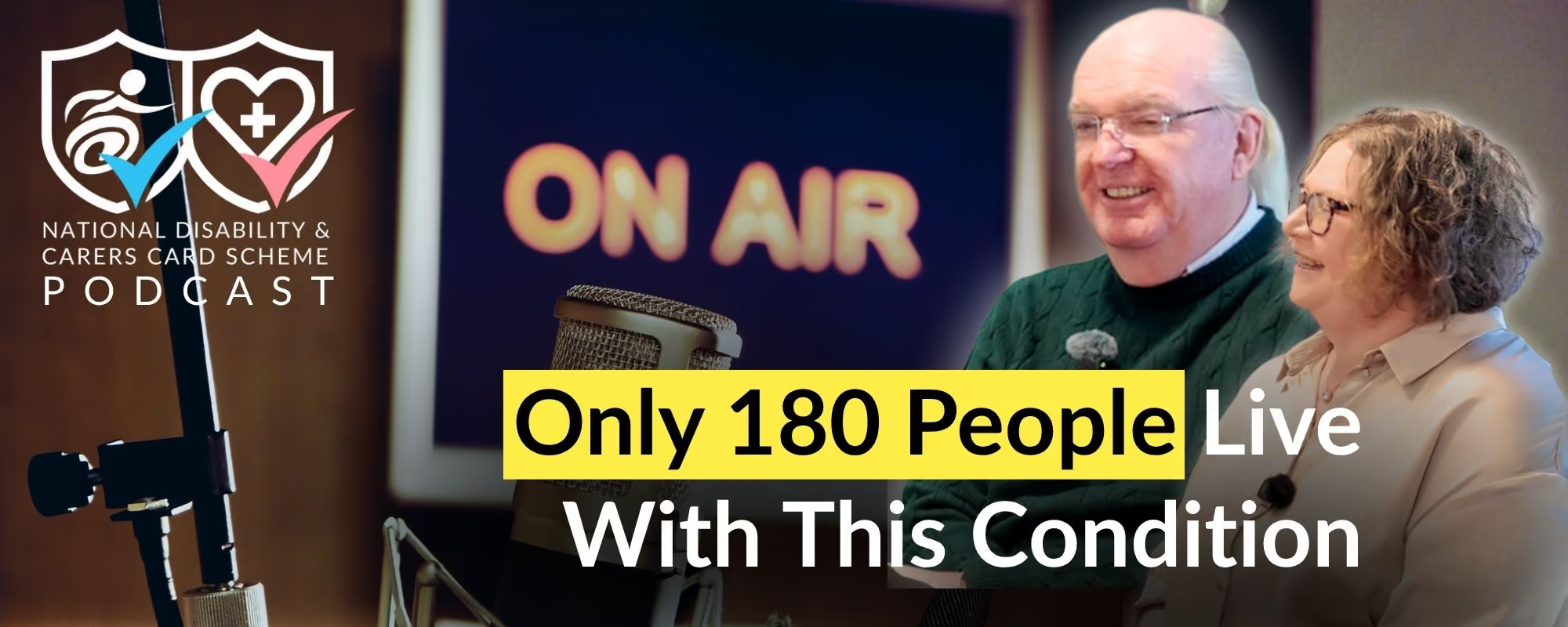
On the latest episode of The National Disability and Carers Card Scheme Podcast, we spoke to Eddie and Suzie about the realities of disability and caregiving. In this interview, they share their experience of living with Pure Autonomic Failure (PAF), a rare progressive condition, and the impact it has had on their daily lives, relationship and future plans.
They also talk about the challenges of hidden disability, the importance of being recognised as a carer, and why they decided to create a support network for others affected by PAF.
Please note the content of the podcast has been abridged and paraphrased for readability. You can watch or listen to the full podcast using the links below.
Can you tell us a little about your journey?
Eddie: “I was diagnosed with a condition called Pure Autonomic Failure nearly a decade ago. It’s a very rare, progressive illness that affects the autonomic nervous system — the things your body does automatically, without you thinking about them.
For me, the worst symptom is postural hypotension, which means my blood pressure crashes whenever I stand up. I have fainted in the past, and even when I do not actually collapse, it has a huge effect on everyday life. The difficulty is that it’s a hidden disability. People often say, “You look so well,” when in reality, I might be on the verge of fainting. It’s such a rare disease that there are only a relatively small number of patients being treated.”
Suzie: “Looking back, the journey probably started before we knew what it was. One morning Eddie had been thrashing around in his sleep, which we later learned was another symptom, and I remember thinking something was really not right.
We did what people are often told not to do - we Googled the symptoms, and Parkinson’s came up. We went to the doctor where Eddie was referred to neurology. That was the beginning of the process that eventually led to the diagnosis of Pure Autonomic Failure.”
Was it difficult to get a confirmed diagnosis?
Eddie: “Yes, because the condition is so rare that many GPs have never heard of it. One of the problems is that people present with a group of symptoms, but medical professionals do not always connect the dots and realise it may be an autonomic disorder. Instead, symptoms can be treated in isolation, without seeing the bigger picture. No two people with PAF have exactly the same symptoms either, which makes it even more complicated.”
What does everyday life with PAF actually look like?
Eddie: “It affects everything. Mornings are especially difficult. I have to stay in bed for a while to let my medication kick in before I can get up. Even something simple like shaving can take much longer because I have to keep stopping and sitting down. Stairs are a real problem. Walking uphill is difficult. I can only walk a short distance before I need to stop. On the outside, people do not see any of that.”
Suzie: “That’s the challenge. People see someone who looks well, and they do not understand why something as simple as making a cup of coffee can be hard. Some days are better than others. On a good day, he can do more. On a bad day, even basic tasks can be impossible.”
How does a hidden disability affect the way other people respond?
Eddie: “It can be very frustrating. Unless I’ve actually collapsed on the floor, people often assume there’s nothing wrong. I have a Blue Badge, and there are times when people look at me as if I should not have one because I don’t “look disabled”.
I’ve fainted in public before, and when that happens people can assume you’re drunk rather than ill.
I remember once being on a packed train and knowing I was seconds away from collapsing. I was wearing my National Disability lanyard, and thankfully someone saw it and gave up their seat. Without that, I would have ended up in a heap on the floor.”
Suzie: “There’s a real gap between appearance and reality. People can be very quick to make assumptions when they cannot see what’s going on.”
How has this impacted your relationship as a husband and wife, compared to the dynamic of a disabled person and their carer?
Eddie: “I’ve seen both sides of it. My first wife had a devastating stroke in 2010, which left her with very significant disabilities. I gave up work to care for her until she passed away in 2016. So I understand what it means to be a carer, and now I understand what it means to need care yourself. When you’re the one receiving care, it can be hard. You know the care is being given with love, but it can still make you feel frustrated or vulnerable.”
Suzie: “I don't separate being a spouse from being a carer. I care because I love him. It’s just part of our life together. Of course there are difficult moments. Sometimes you worry when you’re not there. I still work, and even though I’m only a short distance away, there’s always that thought in the back of my mind: is he okay? Has he fallen? Has he hurt himself?”
What adjustments or support have made the biggest difference?
Suzie: “Assisted rail travel has been brilliant for us. Staff help us get to our seats, and at the other end they help with luggage and onward travel. Without that support, train journeys would be much more difficult.
We’ve also found the National Disability Card and National Carers Card incredibly helpful. They make things visible without us having to keep explaining. At venues, theatres and attractions, staff understand more quickly what support might be needed. Often, the carer can attend free too, which makes a practical difference when you don’t know whether Eddie will be well enough to manage a full visit.”
Has being recognised as a carer made a difference too?
Suzie: "Yes, definitely. Having a National Carers Card makes it clear that I’m not just accompanying Eddie socially, I’m there because he may need support.
What’s been particularly nice is that people do not just look after Eddie, they check on me too. If something happens when we’re out, staff will often ask if I’m alright and whether I need anything. That makes you feel seen and supported as well.”
What would you like more people to understand about living with PAF or caring for someone with a hidden disability?
Eddie: “That you cannot always see disability. Someone may look completely fine and still be struggling enormously just to get through the day. With rare conditions especially, there needs to be more awareness.”
Suzie: “I’d say trust what people tell you about their own experience. If someone says they’re struggling, believe them - even if they look well. And if you’re a partner or family member caring for someone, it’s okay to recognise that role. You’re not “just” a spouse or “just” helping out. What you do matters too.”
 |  |  |
About the National Disability Card
The National Disability Card is a form of visual identification for disabled people across the UK. Set up in 2019 by carers to make everyday life and access easier for people with disabilities and those who care for them, the scheme supports 220,000+ card holders and is accepted as proof of disability at 600+ venues across the UK and abroad.
Conclusion
Eddie and Suzie’s story highlights the significant impact that hidden disabilities can have on daily life, relationships, and mental wellbeing. It emphasises the importance of greater public awareness, recognising invisible conditions, and acknowledging the role of carers. Their experience also shows how building supportive communities can help reduce isolation and provide valuable understanding for those affected by rare conditions like PAF.
Share

.avif)
.avif)